
How Often Should You Do Hyperbaric Oxygen Therapy?
Is there an “ideal” frequency for hyperbaric oxygen therapy — or does it depend on the system you’re working to support?
Questions around frequency are common when people first explore hyperbaric oxygen therapy. How often should sessions occur? Is more always better? And how do clinicians decide what makes sense for an individual?
At Huemn, this question is approached through systems-based thinking rather than fixed schedules.
Hyperbaric oxygen therapy is not treated as a standalone solution or a protocol to follow blindly. It is used as a lever within a broader clinical context — one that considers physiology, recovery capacity, stress load, and adaptive response.
This article outlines how frequency is typically considered, what factors shape clinical decisions, and why there is no universal answer that applies to everyone.
If you’re exploring hyperbaric oxygen therapy and want clarity on whether — and how — it fits into a broader health strategy, structured guidance matters.

Key Takeaways
There is no universal frequency for hyperbaric oxygen therapy
Decisions are based on systems-level assessment
More frequent sessions are not inherently better
Recovery and adaptation guide scheduling
Frequency often changes as physiology changes
Why frequency is not one-size-fits-all
There is no universal answer to how often hyperbaric oxygen therapy should be done. Frequency depends on what system is being supported and how the body is currently functioning.
Hyperbaric exposure influences oxygen availability, cellular signaling, and recovery processes. These effects are context-dependent. In human data, response patterns vary significantly based on baseline stress, metabolic health, inflammatory load, and nervous system tone.
Because of this variability, frequency is not prescribed as a fixed number. It is adjusted to avoid overexposure while still creating a meaningful physiological signal.
What clinicians evaluate before recommending frequency
Before determining how often sessions should occur, clinicians assess several interrelated factors. These include current health status, recovery capacity, lifestyle stressors, and how the individual responds to other interventions.
At a systems level, this assessment focuses on whether the body is in a state of resilience or overload. Hyperbaric oxygen therapy is more effective when layered into a stable foundation rather than used to compensate for unaddressed strain.
This is why frequency decisions are made in context, not in isolation.
Typical session ranges in clinical settings
In clinical environments, hyperbaric oxygen therapy is often used in structured blocks rather than sporadically. Some individuals may begin with a higher frequency over a defined period, while others start more conservatively.
These ranges are not prescriptions. They are frameworks informed by clinical observation and human data, adjusted based on tolerance and response.
Importantly, frequency is reviewed continuously. If adaptation is not occurring as expected, the schedule is reassessed rather than intensified.
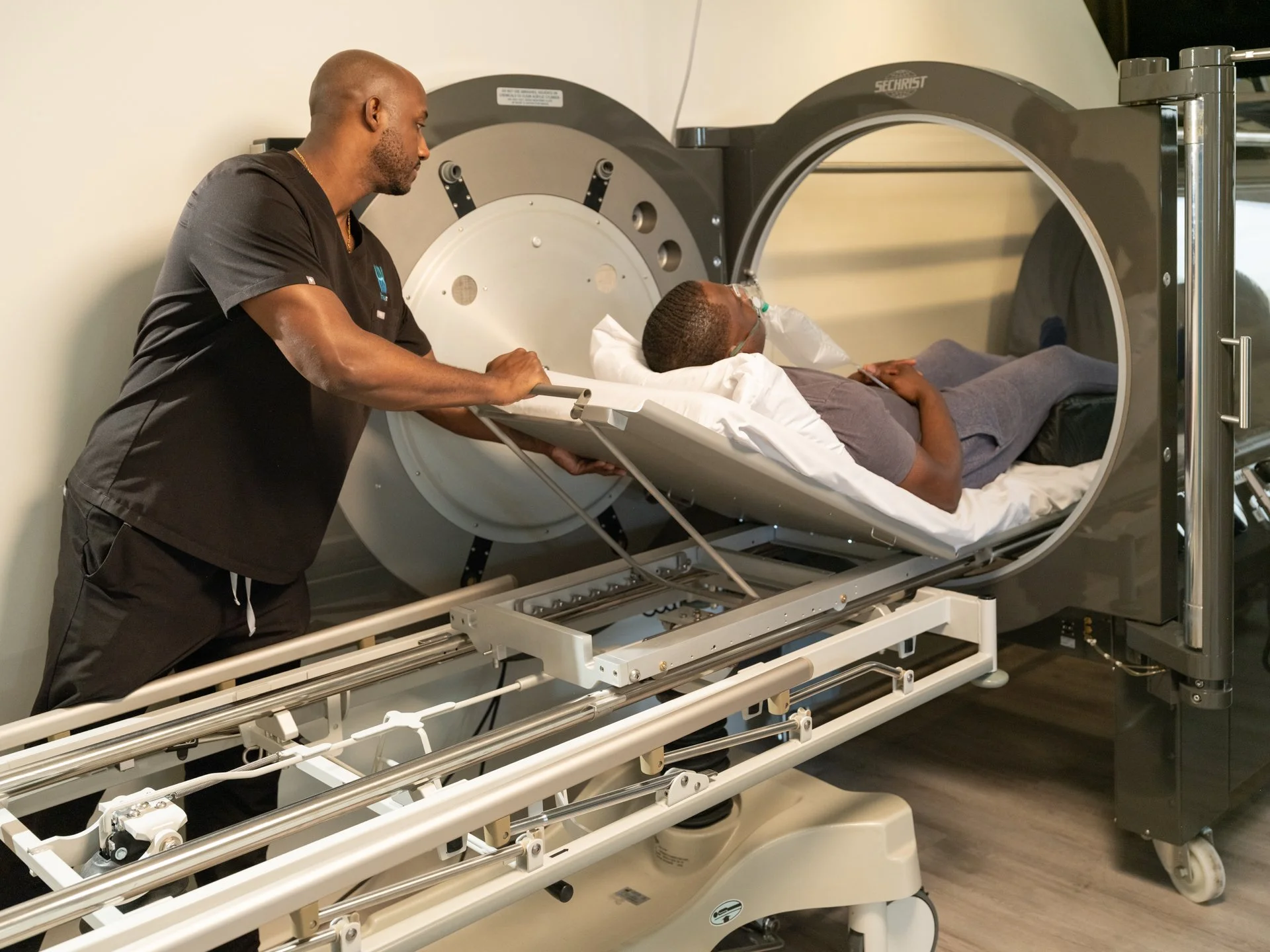
Why adaptation and recovery matter
Hyperbaric oxygen therapy introduces a controlled physiological stressor. Like other adaptive inputs, its value comes from how the body responds — not from repeated exposure alone.
Without adequate recovery, increased frequency can reduce signal clarity and blunt adaptation. This is why rest days, spacing, and overall load are considered part of the intervention.
From a systems perspective, recovery is not passive. It is an active phase where signaling leads to downstream effects.
When frequency may change over time
Frequency is rarely static. As systems stabilize or priorities shift, session cadence may change.
Early phases may involve closer spacing to establish familiarity and response. Later phases often involve reduced frequency as the body integrates the signal and other interventions take precedence.
This progression reflects clinical restraint rather than escalation.
How hyperbaric therapy fits into a wider plan
Hyperbaric oxygen therapy is not used in isolation at Huemn. It is positioned alongside diagnostics, lifestyle inputs, and other clinician-guided therapies.
This integrated approach allows frequency to remain intentional. Instead of asking how often someone should do hyperbaric oxygen therapy, the better question becomes how it fits into the overall strategy.
For those seeking more detail on how this therapy is used clinically, Huemn provides further context on its hyperbaric oxygen therapy in Houston page.
FAQs
-
Frequency depends on individual context, clinical goals, and how the body responds. There is no single schedule that applies to everyone.
-
Daily sessions are sometimes used in structured clinical settings, but they are not required for everyone and are not always appropriate.
-
Excessive frequency without adequate recovery can reduce adaptive response, which is why schedules are adjusted rather than maximized.
-
Clinicians typically monitor response over several sessions, looking at tolerance and systemic signals rather than immediate outcomes.
-
Yes. Session cadence often shifts as systems stabilize or priorities change.
-
Hyperbaric oxygen therapy should be guided within a clinical framework rather than self-scheduled.
Summary
Understanding how often to use hyperbaric oxygen therapy requires restraint, context, and clinical judgment. Frequency is not about chasing outcomes but about supporting adaptive systems responsibly.
Huemn is a science-first, longevity-focused clinic in Houston, Texas, where therapies are positioned within a broader, clinician-led strategy rather than used in isolation.